 info@matrixlankatours.com
 (+94) 75 826 2326

Step Back in Time, Your Friendly Guide to Polonnaruwa, Sri Lanka.
Have you ever wished you could walk through a living history book? Imagine standing among ancient stone ruins, gazing out over massive lakes, and feeling the spirit of a great kingdom that flourished a thousand years ago.
If that sounds exciting, then welcome to Polonnaruwa, Sri Lanka’s second ancient capital.
Many travellers head straight to the beaches or the tea hills. But those who skip Polonnaruwa are missing one of the most magical and historically rich places on earth. It is a place where nature and ancient human genius coexist. This guide will walk you through everything you need to know about this incredible UNESCO World Heritage Site.
Why Polonnaruwa is More Than Just Old Ruins
When people hear the words “ancient ruins,” they often picture dusty rocks in a museum. Polonnaruwa is nothing like that.
It is an open-air wonder surrounded by lush forests, playful monkeys, and enormous man-made lakes that stretch as far as the eye can see. Between the 11th and 13th centuries, this city was a thriving cultural and religious centre. Great kings like Parakramabahu I built grand palaces, vast Buddhist monasteries, and clever irrigation systems, many of which still work today.
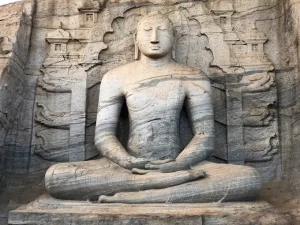
Walking or cycling through this ancient city is not just sightseeing. It is a deeply human experience. Standing before a giant Buddha carved from a single rock face, you feel something quiet and powerful inside you. That feeling is hard to forget.
Practical Tips Before You Go.
- How to Get There.
Polonnaruwa sits in Sri Lanka’s North Central Province, right in the heart of the famous Cultural Triangle.
- From Colombo: About 4 to 5 hours by car or taxi. You can also take a scenic train to nearby Habarana or directly to Polonnaruwa.
- From Sigiriya or Dambulla: Just about one hour by road, making it an easy and rewarding day trip.
- The Best Way to Explore
Without a doubt, a bicycle is the best way to see the ancient city. The park is wide, flat, and shaded by tall trees. You can stop whenever something catches your eye, feel the warm breeze on your face, and explore at your own comfortable pace. If cycling is not for you, a tuk-tuk for the day works just as well.
- What to Wear
Polonnaruwa is a sacred site, so respectful clothing is required. Both men and women must cover their shoulders and knees when entering temple grounds.
- Wear light cotton clothes, as the plains can get very hot.
- Bring a pair of thick socks. You will need to remove your shoes at nearly every monument, and the stone floors can burn your feet under the midday sun.
The Top Sights You Must See
- The Royal Palace Complex
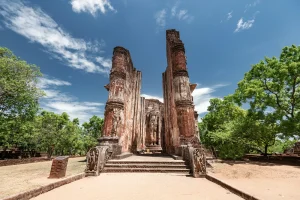
Your journey usually begins here. King Parakramabahu I’s palace, once known as Vaijayanta Prasada, was a magnificent seven-story structure with over a thousand rooms. Today, its thick brick walls still rise impressively, giving you a powerful sense of its past glory.
Nearby, you will find the Royal Audience Hall, decorated with beautifully carved stone elephants at its base, and the Kumara Pokuna, the king’s ancient stone swimming pool, which looks like something from a fantasy novel.
- The Sacred Quadrangle
If you only have one hour in Polonnaruwa, spend it here. This compact, raised terrace is packed with some of the most beautiful religious structures in all of Sri Lanka. It once held the sacred Tooth Relic of the Buddha.
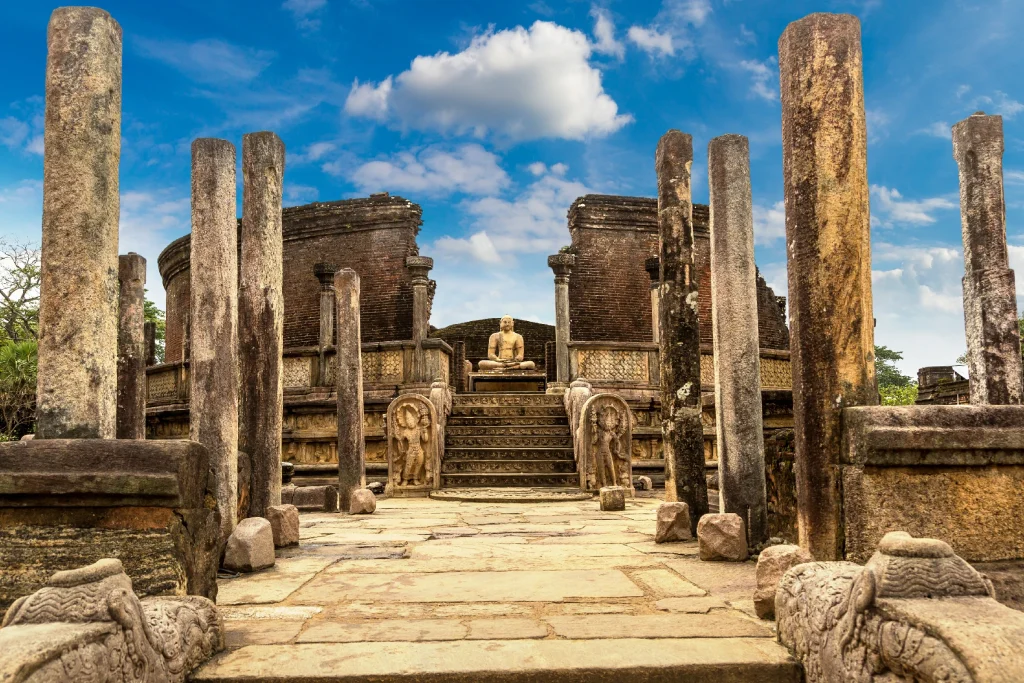
The star of the Sacred Quadrangle is the Vatadage. a circular stone relic house with carved steps, elegant guardian stones, and four peaceful Buddha statues facing each direction of the compass. The craftsmanship is breathtaking.
Nearby are the Hatadage and Atadage, ancient shrines built by different kings to protect the Tooth Relic, and the Nissanka Latha Mandapaya, a unique structure with stone pillars carved to look like bending lotus flowers. It feels almost impossibly delicate for something made of stone.
- Gal Vihara, The Crown Jewel
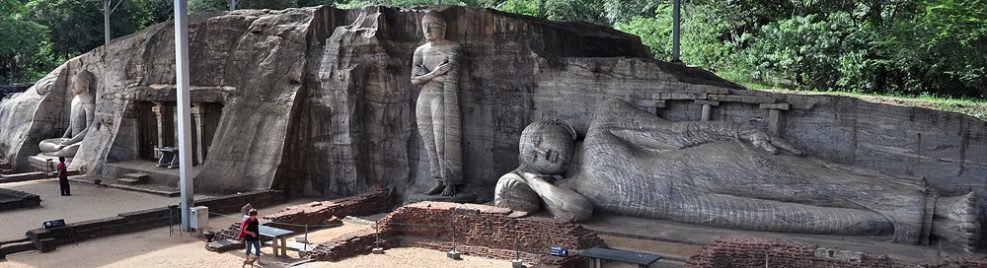
Nothing quite prepares you for Gal Vihara. This “Rock Monastery” features four magnificent Buddha statues carved directly into a single granite rock face.
- A seated Buddha, deep in meditation, with incredible detail in every line.
- A smaller Buddha sheltered inside a cave.
- A rare 7-meter standing Buddha with arms folded, his expression full of quiet compassion.
- A massive 14-meter reclining Buddha, depicted entering Nirvana. The ancient sculptors even carved a soft depression in the stone pillow beneath his head, making hard rock look as gentle as silk.
Sitting quietly in front of these carvings is one of those travel moments that stays with you for life.
- The Great Stupas: Rankot Vihara and Kiri Vihara
As you move further through the park, great brick domes begin to appear above the trees.
Rankot Vihara is the largest stupa in Polonnaruwa and the fourth largest in the country. At roughly 55 meters tall, it radiates a sense of enormous, grounded power.
Kiri Vihara, meaning “Milk White Stupa,” hid beneath thick jungle for nearly a thousand years. When archaeologists finally cleared the overgrowth, they discovered the original white lime plaster still largely intact. It gleams beautifully against the green forest, looking almost freshly built.
An Engineering Wonder.
- Parakrama Samudraya (The Sea of Parakrama)
To truly understand Polonnaruwa, you need to understand its water.
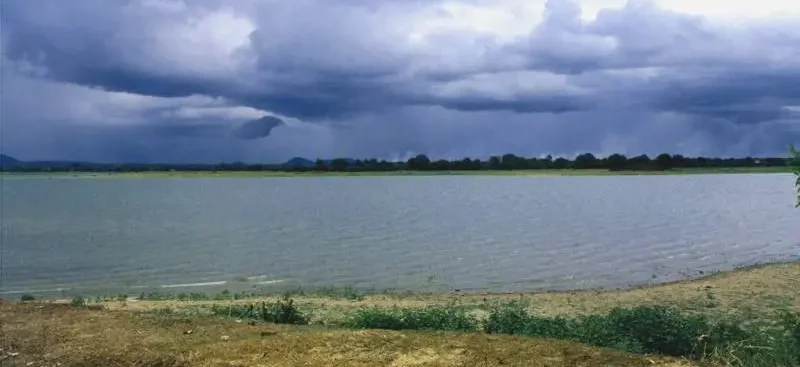
King Parakramabahu I once declared that not a single drop of rainwater should reach the ocean without first serving humanity. He meant it. He built the Parakrama Samudra, an enormous man-made reservoir covering over 25 square kilometres. It is so vast that it creates its own small waves and genuinely looks like an inland sea.
This lake did not just supply water to the city. It powered an entire agricultural civilisation, earning Sri Lanka the title “Granary of the East.” Watching the sunset over the Parakrama Samudra, with local fishermen paddling in their canoes and flocks of birds flying overhead, is the perfect way to end your day.
- Where Wildlife Meets Ancient History
One of the great joys of visiting Polonnaruwa is the wildlife. The ruins sit within a large forest reserve, so you are never exploring alone.
Polonnaruwa is famous for its large troops of Toque Macaque monkeys, the very same ones featured in Disney’s nature documentary, Monkey Kingdom. Watching them leap across ancient stone walls and groom each other in the sunshine brings a wonderful sense of life to the historical site.
Keep your eyes open for giant water monitors sunning themselves on warm rocks, spotted deer grazing quietly near the forest edges, and a wide variety of tropical birds flying overhead.
Written by MMS.